How Do You Manage Global Training Content Without Losing Your Mind?
Managing training content in just one country is already a big job. It takes time, effort, and a lot of coordination. Now think about doing the same thing for five, ten, or even twenty different countries. Each place has its own language, Its own culture and Its own rules and expectations.
Very quickly, something that felt simple starts to feel complicated.
In the beginning, it doesn’t seem too bad. You create one training video, one guide, one system. Everything looks organized. You feel like you’re done. But then things start to change.
Someone says, “Can we have this in Urdu?”
Another person asks, “We need a Spanish version too.”
Then comes, “What about Arabic?”
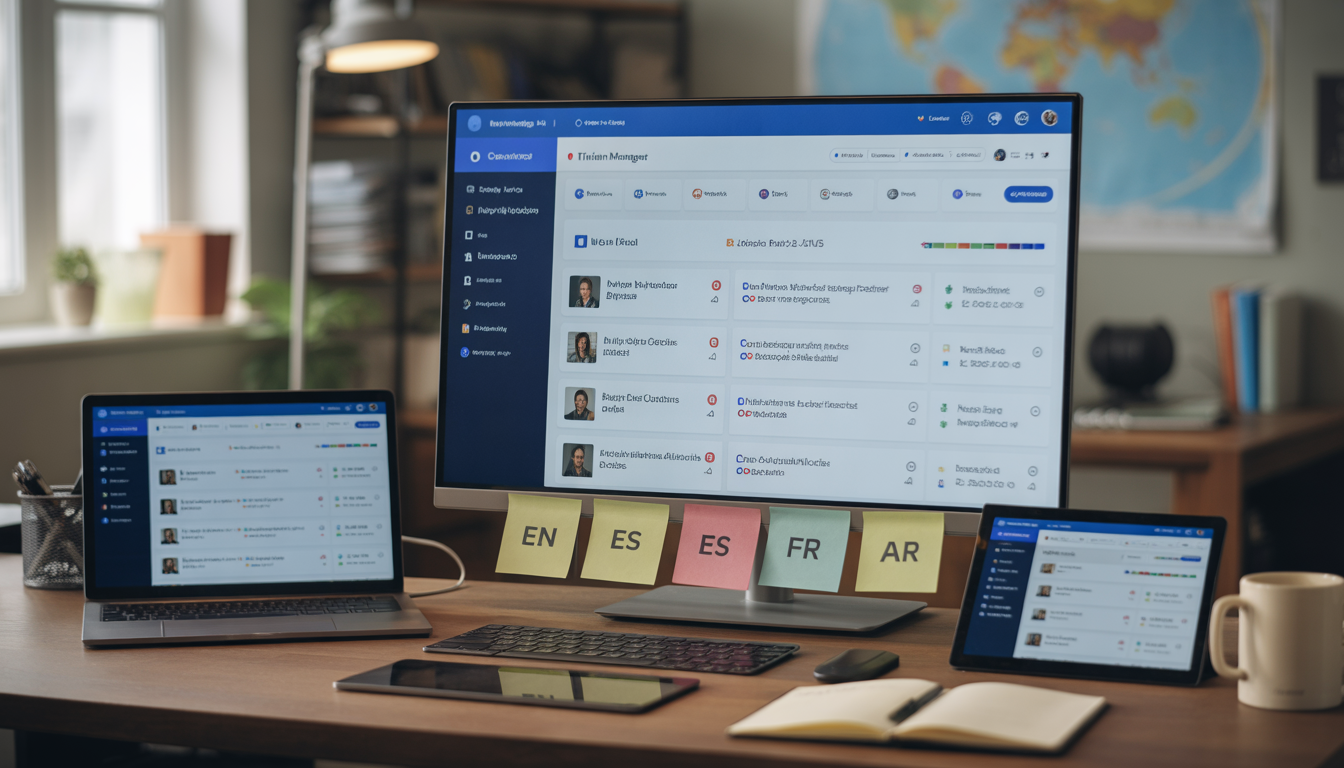
And just like that, your one simple training turns into multiple versions Now you’re not just managing content, you’re managing many versions of the same content. Every update has to be repeated again and again. Fix one small mistake? You have to fix it everywhere.
It slows you down.
It increases costs.
And over time, it becomes frustrating.
You might even start wondering if there’s a better way to do all this. Now You don’t have to keep doing the same work over and over. There’s a simpler, smarter way to manage global training content without feeling stressed or overwhelmed. And once you understand how it works, things start to feel much more clear and under control.
Why Global Training Content Feels So Complicated
Before we fix anything, let’s look at what’s actually going wrong. Most teams aren’t bad at creating training. The real problem is that their system doesn’t scale.
Here’s what usually happens:
- You create separate versions for every country
- Updates take forever
- Costs keep increasing
- Content starts to feel inconsistent
- Nobody knows which version is the latest
And over time, things get out of control. You end up with files named something like:
“Final_v3_latest_REAL_final_use_this_one.mp4”
We’ve all been there. The real issue isn’t the work, it’s the lack of a clear system.
A Better Way to Think About It
Instead of thinking, “Let’s create training for each country”
Try thinking,
“Let’s create one strong system that works everywhere.”
It’s a small shift, but it changes everything. The goal becomes simple:
Create once.
Adapt easily.
Use everywhere.
Step 1: Start With One Clean Master Version
Think of this as your main file, the base of everything. This version should be simple, clear, and easy to understand.
- Use plain language
- Avoid inside jokes or local references
- Break content into small sections
- Keep visuals neutral
Why this matters:
If your main version is confusing, every translated version will be confusing too. But if it’s clean and simple, Everything else becomes easier.
Step 2: Write Like You’re Talking to a Real Person
This is where a lot of people go wrong. Training content often sounds too formal. Too robotic. But people don’t learn well from complicated language. Here’s a simple rule:
If a 12-year-old can’t understand it, simplify it.
For example:
Instead of saying,
“Ensure compliance with organizational protocols…”
Just say,
“Follow your company’s rules.”
Same meaning. Much easier.
And when your content is easy to understand, it’s also easier to translate.
Step 3: Think About Languages Early
Most teams create content first and worry about translation later. That’s where problems start.
You might run into:
- Text that doesn’t fit subtitles
- Words that don’t match visuals
- Extra work fixing everything
A better approach is to plan ahead.
- Leave space for subtitles
- Avoid putting text inside images
- Keep sentences short
- Skip slang
It might feel like a small thing, but it saves a lot of time later.
Step 4: Use AI Dubbing to Save Time (Big Advantage)
Now let’s talk about one of the hardest parts, voiceovers.
Traditionally, dubbing means:
- Hiring voice actors
- Booking recording sessions
- Editing audio
- Doing it again for every language
It takes time. And it costs a lot. Now imagine this instead:
You upload your video.
Pick a language.
And within a few hours, you have a new version with a natural voice.
That’s what AI dubbing does.
Why it’s becoming so popular:
- It’s fast (hours instead of weeks)
- It’s more affordable
- Voices sound natural now
- You can update content anytime
Let’s say you fix one mistake in your training. With traditional dubbing, you redo everything. With AI dubbing? You just update and regenerate.
Traditional vs AI Dubbing (Quick Look)
| Feature | Traditional Way | AI Dubbing |
| Time | Slow | Fast |
| Cost | High | Lower |
| Updates | Difficult | Easy |
| Scaling | Hard | Simple |
| Consistency | Varies | Stable |
Step 5: Keep Everything in One Place
Another common problem? Content is everywhere.
Some files are in emails.
Some are in folders.
Some are lost completely.
This creates confusion. Instead, use one central system like an LMS (Learning Management System).
This helps you:
- Keep everything organized
- Make updates easily
- Avoid duplicate files
- Track who has completed training
It brings structure to your process.
Step 6: Follow a Simple Workflow
You don’t want to start from scratch every time. You want a system you can repeat.
Here’s a simple one:
- Create your main content
- Translate the script
- Use AI dubbing
- Review with local team
- Publish
That’s it. Once you follow this a few times, it becomes easy.
Step 7: Pay Attention to Culture
Translation changes words.
Localization changes meaning.
For example, something funny in one country might not make sense in another.
So always check:
- Tone
- Examples
- Images
- Symbols
Even small changes can make your content feel more natural.
Step 8: Track What Works
Once your training is live, don’t just forget about it.
Look at:
- Are people finishing it?
- Are they understanding it?
- Where do they get stuck?
- What feedback do they give?
This helps you improve over time.
A Simple Way to Understand the Problem (PAS)
Problem:
Managing training across different countries can quickly become messy and stressful. What starts as one simple training program turns into multiple versions for different languages and regions. You’re trying to keep everything updated, organized, and consistent but it feels like things are slipping out of control.
Agitation:
The more it grows, the harder it gets. Updates take longer than expected. Costs keep increasing because you’re repeating the same work again and again. Teams start getting confused about which version is correct. Small mistakes turn into big problems because they exist in multiple places. And instead of focusing on improving the training, you’re stuck just trying to manage it.
Solution:
The answer isn’t to work more, it’s to work smarter. By using a simple, structured system, you can manage everything in a much cleaner way. Create one main version, make updates in one place, and then adapt it easily for different regions. And with tools like AI dubbing, you can quickly turn your content into multiple languages without starting from scratch every time.
Sometimes, the real improvement doesn’t come from putting in more effort.
It comes from finding a better way to do the same work, faster, easier, and with less stress.
Simple Tips You Can Start Today
If you’re not sure where to begin, start small:
- Break content into smaller parts
- Use simple language
- Stick to one main version
- Try AI tools
- Test with real users
You don’t need to fix everything at once.
FAQs
What is global training content?
Global training content is any learning material like videos, guides, or courses that is created for people in different countries. It’s designed so that learners from different languages and backgrounds can understand and use it easily.Why is it difficult to manage?
It becomes difficult because every region is different. You have to deal with multiple languages, cultural differences, and frequent updates. Even a small change in content can mean updating many versions, which takes time and effort.What’s the easiest way to manage it?
The simplest way is to create one main (master) version of your training and then adapt it for different regions. This way, you only update one source and then apply those changes everywhere else.Is translation enough?
No, translation alone is not enough. You also need localization, which means adjusting the content to fit the culture, tone, and expectations of different regions. This makes the training feel more natural and relatable.What is AI dubbing?
AI dubbing is a tool that automatically creates voiceovers in different languages. Instead of recording new audio every time, you can use AI to generate natural-sounding voices quickly.Does AI dubbing sound real?
Yes, modern AI voices sound very natural. In most cases, people can’t even tell the difference between AI-generated audio and a human voice, especially for training content.Is AI dubbing expensive?
Not at all. Compared to traditional dubbing which involves hiring voice actors and studios. AI dubbing is much more affordable and cost-effective, especially when scaling to multiple languages.Can beginners use AI dubbing?
Yes, most AI dubbing tools are designed to be simple and user-friendly. Even if you have no technical experience, you can easily learn how to use them.How often should training be updated?
Training should be updated whenever there is a change like new policies, updated processes, or product changes. Keeping content fresh ensures that learners always get accurate information.Do I need an LMS (Learning Management System)?
It’s not absolutely required, but it makes things much easier. An LMS helps you organize content, track progress, and manage different versions in one place, saving time and effort in the long run.Final Thoughts: Keep It Simple
Don’t make it harder than it needs to be.
You don’t need a perfect system. You don’t need a big team.
You just need:
- One clean version
- A simple process
- The right tools
And honestly, AI dubbing is one of those tools that just makes everything smoother.
It saves time.
It reduces cost.
And it removes a lot of stress.