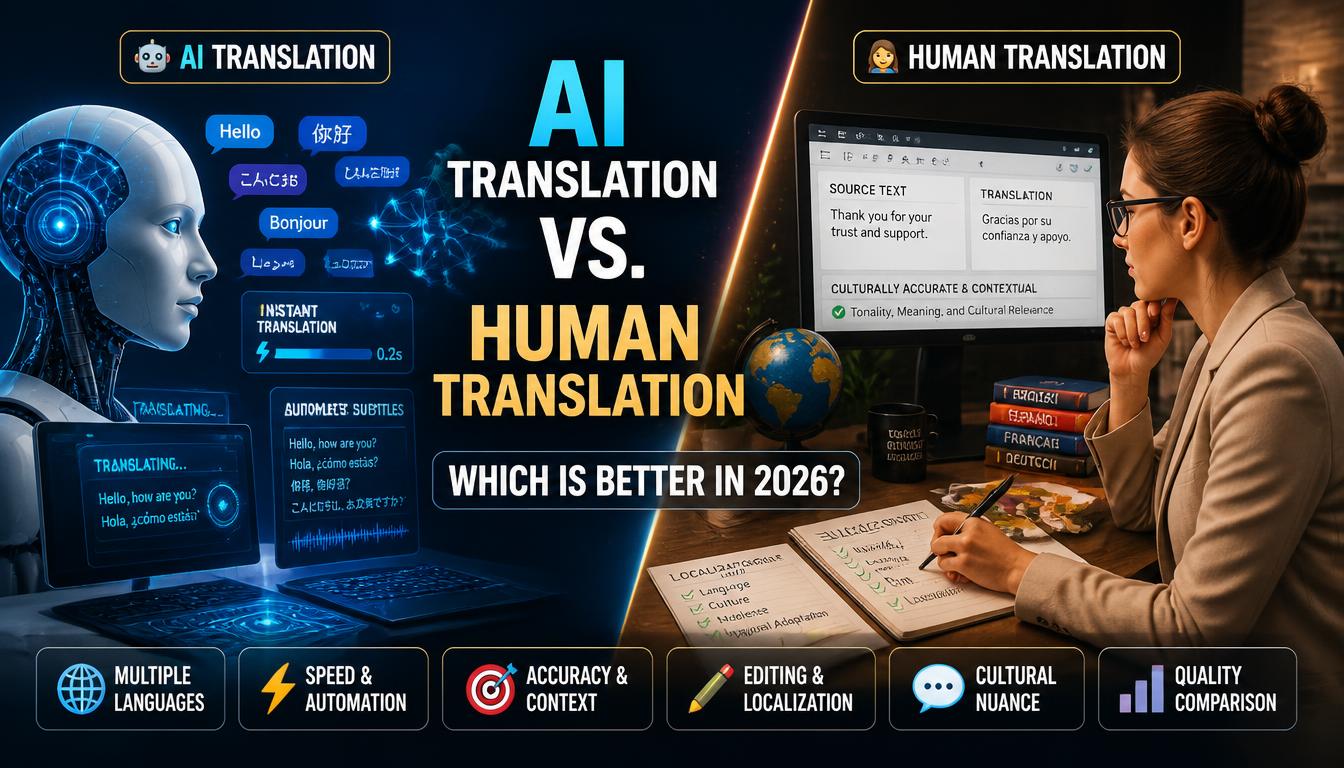
Global communication has never been easier. Whether you’re creating YouTube videos, translating business documents, or expanding your brand into new markets, reaching people in their own language is more important than ever. That’s where translation comes in.
Today, you have two main options: AI translation and human translation. AI tools can translate text, subtitles, and even voice-overs in minutes. Human translators, on the other hand, bring cultural understanding, creativity, and deep language expertise. So, which one should you choose?
The answer isn’t as simple as picking one over the other. Each option has its strengths, and the right choice depends on your goals, budget, timeline, and the type of content you’re translating.
By the end, you’ll know exactly which solution fits your needs.
AI translation is the process of using artificial intelligence to automatically convert text, audio, or video from one language into another. Unlike older machine translation systems that translated words one by one, modern AI uses Neural Machine Translation (NMT). This technology analyzes entire sentences to understand meaning, grammar, and context before generating a translation.
As a result, today’s AI translators produce much smoother and more natural translations than earlier systems. AI translation isn’t limited to written text anymore. Many modern platforms can also:
This makes AI translation especially useful for creators, businesses, educators, and marketers who need to publish multilingual content quickly.
Although it happens in seconds, AI translation follows several steps behind the scenes.
1. It Understands the Original Language
The AI first analyzes the source text or speech to identify grammar, sentence structure, and meaning.
2. It Predicts the Best Translation
Instead of translating word by word, modern AI predicts the most natural sentence in the target language.
3. It Preserves Context
Advanced language models look at surrounding words and phrases to avoid awkward or literal translations.
4. It Generates the Final Output
The translated content is then presented as text, subtitles, or even a natural-sounding AI voice.
This entire process often takes just a few seconds.
AI translation has become incredibly popular because it offers several advantages.
Perhaps the biggest advantage is speed. A document that might take a professional translator several hours can often be translated by AI in under a minute.
This makes AI perfect for:
Hiring professional translators can become expensive, especially when translating thousands of words or multiple languages.
Many AI translation platforms offer:
This makes AI accessible even for small creators and startups.
Most leading AI translation tools support dozens or even hundreds of languages. This allows businesses to reach global audiences without hiring translators for every language.
Imagine translating one YouTube video into 30 languages. With human translators, this could take weeks. With AI, it may only take a few hours. That scalability is one reason AI has become so popular among content creators.
Modern AI platforms don’t just translate written content.
Many also support:
This saves creators countless hours of manual editing.
AI translation is now used across many industries.
Some common examples include:
For these types of content, speed often matters more than perfect literary accuracy, making AI an excellent solution.
Human translation is the process of translating content manually by a professional translator who understands both the source and target languages. Unlike AI, human translators don’t simply convert words. They interpret meaning, emotion, tone, cultural references, and intent before choosing the most appropriate translation. That’s why human translation remains the gold standard for many sensitive and high-value projects. Professional translators often specialize in areas such as:
Their expertise helps ensure the translation is not only accurate but also natural and culturally appropriate.
Professional translation involves much more than replacing one language with another. A typical workflow includes:
The translator carefully reads the original content to understand its meaning, purpose, audience, and tone.
If technical terms, legal phrases, or industry-specific language appear, the translator researches them to ensure accuracy.
The content is translated while preserving:
The translator reviews and improves the wording to make it sound natural.
Finally, the translated content is checked for grammar, spelling, consistency, and formatting before delivery.
This careful process takes longer than AI translation but often results in higher-quality output for complex content.
Human translators provide advantages that AI still struggles to match.
Languages contain idioms, humor, traditions, and expressions that don’t always translate directly. A professional translator understands these cultural differences and adapts the message accordingly.
For example, a joke that works in English may make no sense in Japanese or Arabic. A human translator knows how to rewrite it naturally.
Marketing campaigns, novels, speeches, and movie dialogue rely heavily on emotion.
Humans understand:
These are areas where AI can still make mistakes.
For legal contracts, medical reports, financial documents, or scientific research, even a small translation error can have serious consequences.
Professional translators carefully verify terminology and context to minimize risk.
Sometimes translation isn’t enough. Content needs localization.
Instead of translating word for word, human translators rewrite phrases so they feel completely natural to local audiences.
This is especially important for:
Localization helps preserve the original message while making it feel authentic in another language.
Now that you understand how both approaches work, let’s compare them across the areas that matter most. While AI translation has improved dramatically in recent years, human translators still offer advantages in situations where accuracy, creativity, and cultural understanding are essential.
The best choice depends on your project, not on whether one method is universally “better.”
Like any technology, AI translation has strengths and limitations.
Pros
Cons
Professional translators continue to play a critical role in global communication.
Pros
Cons
AI translation is the right choice when speed, affordability, and scalability matter most. It’s especially useful for content that needs to reach a global audience quickly.
Great Use Cases for AI Translation
For example, if you’re a YouTube creator uploading videos every week, AI can automatically translate subtitles and generate natural-sounding voice-overs in multiple languages. Instead of spending days preparing localized versions, you can reach viewers around the world much faster.
Some content demands a level of precision and cultural understanding that AI alone cannot guarantee.
Choose a professional human translator when you’re working with:
In these situations, even a small translation mistake could lead to misunderstandings, legal issues, or damage to your brand’s reputation.
This is one of the most common questions people ask. The short answer is no, not completely.
AI has become incredibly capable and continues to improve every year. It can handle many routine translation tasks quickly and accurately, making it an excellent choice for everyday content.
However, language is more than just words. It includes emotion, culture, humor, creativity, and human experience. A professional translator can understand these subtle details in ways that AI still struggles to replicate. Rather than replacing human translators, AI is changing how they work. Many professionals now use AI to speed up the first draft and then refine the translation manually to ensure it sounds natural and accurate.
This combination offers the best balance between speed and quality.
Many businesses no longer see AI and human translation as competing options. Instead, they combine both to get the best possible results.
This approach is often called AI-assisted translation or human-in-the-loop translation.
Here’s how it works:
This workflow offers several advantages:
For businesses translating websites, marketing materials, or educational content into multiple languages, this hybrid approach often delivers the best balance of speed, quality, and cost.
With so many AI translation platforms available, choosing the right one can feel overwhelming. The best tool depends on the type of content you want to translate.
Even the best translation tools can produce poor results if they’re used incorrectly. Avoid these common mistakes to improve quality and accuracy.
AI is impressive, but it isn’t perfect. Always review important translations before publishing, especially for customer-facing content.
A phrase that sounds natural in one language may confuse or even offend people in another.
Whenever possible, adapt your content for local audiences instead of translating it word for word.
Not every AI translator is built for the same purpose.
For example:
Using the right tool improves both quality and efficiency.
Small grammar mistakes, formatting issues, or incorrect names can reduce your credibility. A quick review before publishing can prevent embarrassing errors.
The AI translation vs. human translation debate isn’t about choosing one over the other, it’s about using the right tool for the right job. AI translation is fast, affordable, and ideal for translating large volumes of text, subtitles, audio, and videos. Human translation, however, remains the best choice for legal, medical, creative, and culturally sensitive content where accuracy and context matter most.
For many businesses, a hybrid approach works best. AI handles the initial translation quickly, while a human reviews the content for accuracy, tone, and natural flow. As AI continues to evolve, it will make translation more efficient, but human expertise will remain essential for delivering high-quality, culturally accurate communication.
Today, you have two main options: AI translation and human translation. AI tools can translate text, subtitles, and even voice-overs in minutes. Human translators, on the other hand, bring cultural understanding, creativity, and deep language expertise. So, which one should you choose?
The answer isn’t as simple as picking one over the other. Each option has its strengths, and the right choice depends on your goals, budget, timeline, and the type of content you’re translating.
In this guide, you’ll learn:
- What AI translation is
- How human translation works
- The biggest differences between them
- The pros and cons of each approach
- When to use AI and when a human translator is the better choice
By the end, you’ll know exactly which solution fits your needs.
What Is AI Translation?
AI translation is the process of using artificial intelligence to automatically convert text, audio, or video from one language into another. Unlike older machine translation systems that translated words one by one, modern AI uses Neural Machine Translation (NMT). This technology analyzes entire sentences to understand meaning, grammar, and context before generating a translation.
As a result, today’s AI translators produce much smoother and more natural translations than earlier systems. AI translation isn’t limited to written text anymore. Many modern platforms can also:
- Translate videos
- Generate subtitles
- Create AI voice-overs
- Dub movies and podcasts
- Translate meetings in real time
- Localize social media content
This makes AI translation especially useful for creators, businesses, educators, and marketers who need to publish multilingual content quickly.
How AI Translation Works
Although it happens in seconds, AI translation follows several steps behind the scenes.
1. It Understands the Original Language
The AI first analyzes the source text or speech to identify grammar, sentence structure, and meaning.
2. It Predicts the Best Translation
Instead of translating word by word, modern AI predicts the most natural sentence in the target language.
3. It Preserves Context
Advanced language models look at surrounding words and phrases to avoid awkward or literal translations.
4. It Generates the Final Output
The translated content is then presented as text, subtitles, or even a natural-sounding AI voice.
This entire process often takes just a few seconds.
Benefits of AI Translation
AI translation has become incredibly popular because it offers several advantages.
1. Fast Results
Perhaps the biggest advantage is speed. A document that might take a professional translator several hours can often be translated by AI in under a minute.
This makes AI perfect for:
- Urgent projects
- Daily business communication
- Social media content
- Video localization
2. Lower Cost
Hiring professional translators can become expensive, especially when translating thousands of words or multiple languages.
Many AI translation platforms offer:
- Free plans
- Monthly subscriptions
- Unlimited translations
- Affordable pricing for businesses
This makes AI accessible even for small creators and startups.
3. Supports Many Languages
Most leading AI translation tools support dozens or even hundreds of languages. This allows businesses to reach global audiences without hiring translators for every language.
4. Easy to Scale
Imagine translating one YouTube video into 30 languages. With human translators, this could take weeks. With AI, it may only take a few hours. That scalability is one reason AI has become so popular among content creators.
5. Works Beyond Text
Modern AI platforms don’t just translate written content.
Many also support:
- Video translation
- AI dubbing
- Voice cloning
- Subtitle generation
- Speech translation
- Automatic captions
This saves creators countless hours of manual editing.
Common Uses of AI Translation
AI translation is now used across many industries.
Some common examples include:
- YouTube videos
- TikTok videos
- Online courses
- Product demonstrations
- Marketing campaigns
- Customer support
- Websites
- Mobile apps
- Podcasts
- Business presentations
- E-learning content
- Social media posts
For these types of content, speed often matters more than perfect literary accuracy, making AI an excellent solution.
What Is Human Translation?
Human translation is the process of translating content manually by a professional translator who understands both the source and target languages. Unlike AI, human translators don’t simply convert words. They interpret meaning, emotion, tone, cultural references, and intent before choosing the most appropriate translation. That’s why human translation remains the gold standard for many sensitive and high-value projects. Professional translators often specialize in areas such as:
- Legal translation
- Medical translation
- Technical documentation
- Marketing copy
- Literature
- Academic research
- Government documents
Their expertise helps ensure the translation is not only accurate but also natural and culturally appropriate.
How Human Translation Works
Professional translation involves much more than replacing one language with another. A typical workflow includes:
1. Understanding the Source
The translator carefully reads the original content to understand its meaning, purpose, audience, and tone.
2. Research
If technical terms, legal phrases, or industry-specific language appear, the translator researches them to ensure accuracy.
3. Translation
The content is translated while preserving:
- Meaning
- Tone
- Style
- Intent
- Cultural relevance
4. Editing
The translator reviews and improves the wording to make it sound natural.
5. Proofreading
Finally, the translated content is checked for grammar, spelling, consistency, and formatting before delivery.
This careful process takes longer than AI translation but often results in higher-quality output for complex content.
Benefits of Human Translation
Human translators provide advantages that AI still struggles to match.
1. Deep Cultural Understanding
Languages contain idioms, humor, traditions, and expressions that don’t always translate directly. A professional translator understands these cultural differences and adapts the message accordingly.
For example, a joke that works in English may make no sense in Japanese or Arabic. A human translator knows how to rewrite it naturally.
2. Better Emotional Tone
Marketing campaigns, novels, speeches, and movie dialogue rely heavily on emotion.
Humans understand:
- Humor
- Sarcasm
- Irony
- Persuasion
- Empathy
- Storytelling
These are areas where AI can still make mistakes.
3. Higher Accuracy for Complex Content
For legal contracts, medical reports, financial documents, or scientific research, even a small translation error can have serious consequences.
Professional translators carefully verify terminology and context to minimize risk.
4. Creative Adaptation
Sometimes translation isn’t enough. Content needs localization.
Instead of translating word for word, human translators rewrite phrases so they feel completely natural to local audiences.
This is especially important for:
- Advertisements
- Brand slogans
- Website copy
- Movie scripts
- Books
- Creative writing
Localization helps preserve the original message while making it feel authentic in another language.
AI Translation vs. Human Translation: Side-by-Side Comparison
Now that you understand how both approaches work, let’s compare them across the areas that matter most. While AI translation has improved dramatically in recent years, human translators still offer advantages in situations where accuracy, creativity, and cultural understanding are essential.
The best choice depends on your project, not on whether one method is universally “better.”
| Feature | AI Translation | Human Translation |
| Speed | Translates in seconds or minutes | Can take hours or days |
| Cost | Low-cost or subscription-based | Higher cost per word or project |
| Accuracy | Excellent for general content | Excellent for complex and sensitive content |
| Context Understanding | Good, but may miss subtle meanings | Excellent understanding of context |
| Cultural Awareness | Limited | Strong cultural knowledge |
| Creativity | Limited | High |
| Scalability | Can translate thousands of files quickly | Difficult to scale large projects |
| Consistency | Very consistent terminology | Depends on the translator |
| Video Dubbing | Fast AI voice generation | Requires voice actors and studio work |
| Best For | Everyday content, videos, websites | Legal, medical, literary, and creative work |
Pros and Cons of AI Translation
Like any technology, AI translation has strengths and limitations.
Pros
- Extremely fast for translating text, audio, and video.
- Affordable compared to hiring professional translators.
- Supports dozens or even hundreds of languages.
- Excellent for large-scale translation projects.
- Can automatically generate subtitles, captions, and AI voice-overs.
- Easy to use, even for beginners.
- Perfect for creators who publish content regularly.
Cons
- May misunderstand cultural references or idioms.
- Can produce awkward or overly literal translations.
- Less effective for highly creative writing.
- Sometimes struggles with complex legal or medical terminology.
- Often requires human proofreading for important content.
Pros and Cons of Human Translation
Professional translators continue to play a critical role in global communication.
Pros
- Excellent understanding of context and intent.
- Preserves emotional tone and storytelling.
- Adapts content for local cultures.
- Highly accurate for technical, legal, and medical content.
- Produces polished, publication-ready translations.
Cons
- More expensive than AI.
- Slower turnaround times.
- Difficult to scale for large multilingual projects.
- Availability depends on translator schedules.
- Costs increase as word count grows.
When Should You Use AI Translation?
AI translation is the right choice when speed, affordability, and scalability matter most. It’s especially useful for content that needs to reach a global audience quickly.
Great Use Cases for AI Translation
- YouTube videos
- TikTok videos
- Instagram Reels
- Online courses
- Product demonstrations
- Company training videos
- Blog posts
- Website localization
- Customer support articles
- E-commerce product descriptions
- Podcasts
- Social media posts
- Presentation subtitles
For example, if you’re a YouTube creator uploading videos every week, AI can automatically translate subtitles and generate natural-sounding voice-overs in multiple languages. Instead of spending days preparing localized versions, you can reach viewers around the world much faster.
When Should You Use Human Translation?
Some content demands a level of precision and cultural understanding that AI alone cannot guarantee.
Choose a professional human translator when you’re working with:
- Legal contracts
- Medical records
- Clinical research
- Government documents
- Immigration paperwork
- Financial reports
- Books and novels
- Movie scripts
- Advertising campaigns
- Luxury brand messaging
- Sensitive business communications
In these situations, even a small translation mistake could lead to misunderstandings, legal issues, or damage to your brand’s reputation.
Can AI Replace Human Translators?
This is one of the most common questions people ask. The short answer is no, not completely.
AI has become incredibly capable and continues to improve every year. It can handle many routine translation tasks quickly and accurately, making it an excellent choice for everyday content.
However, language is more than just words. It includes emotion, culture, humor, creativity, and human experience. A professional translator can understand these subtle details in ways that AI still struggles to replicate. Rather than replacing human translators, AI is changing how they work. Many professionals now use AI to speed up the first draft and then refine the translation manually to ensure it sounds natural and accurate.
This combination offers the best balance between speed and quality.
AI + Human Editing: The Best of Both Worlds
Many businesses no longer see AI and human translation as competing options. Instead, they combine both to get the best possible results.
This approach is often called AI-assisted translation or human-in-the-loop translation.
Here’s how it works:
- AI creates a fast first draft.
- A professional translator reviews the content.
- The translator corrects errors, improves wording, and adapts cultural references.
- The final translation is polished and ready for publication.
This workflow offers several advantages:
- Faster turnaround than human translation alone.
- Lower costs compared to fully manual translation.
- Higher accuracy than AI-only output.
- Natural, localized content that resonates with the target audience.
For businesses translating websites, marketing materials, or educational content into multiple languages, this hybrid approach often delivers the best balance of speed, quality, and cost.
Best AI Translation Tools
With so many AI translation platforms available, choosing the right one can feel overwhelming. The best tool depends on the type of content you want to translate.
| Tool | Best For | Languages | AI Voice | Subtitle Translation | AI Dubbing | Free Plan |
| Dubright | Video translation & AI dubbing | 100+ | ✅ | ✅ | ✅ | Yes |
| DeepL | High-quality text translation | 30+ | ❌ | ❌ | ❌ | Yes |
| Google Translate | Everyday translations | 130+ | Limited | ❌ | ❌ | Yes |
| Microsoft Translator | Business & productivity | 100+ | Limited | ❌ | ❌ | Yes |
| ChatGPT | Context-aware writing & translation | Multiple | ❌ | ❌ | ❌ | Yes (limited) |
| HeyGen | AI avatar videos | 40+ | ✅ | ✅ | ✅ | Limited |
| Rask AI | Video localization | 130+ | ✅ | ✅ | ✅ | Limited |
Common Mistakes to Avoid
Even the best translation tools can produce poor results if they’re used incorrectly. Avoid these common mistakes to improve quality and accuracy.
1. Trusting AI Without Reviewing the Output
AI is impressive, but it isn’t perfect. Always review important translations before publishing, especially for customer-facing content.
2. Ignoring Cultural Differences
A phrase that sounds natural in one language may confuse or even offend people in another.
Whenever possible, adapt your content for local audiences instead of translating it word for word.
3. Choosing the Wrong Tool
Not every AI translator is built for the same purpose.
For example:
- Use text translators for articles and documents.
- Use AI dubbing tools for videos.
- Use subtitle translation tools for films, tutorials, and online courses.
Using the right tool improves both quality and efficiency.
4. Forgetting to Proofread
Small grammar mistakes, formatting issues, or incorrect names can reduce your credibility. A quick review before publishing can prevent embarrassing errors.
5. Prioritizing Speed Over Quality
AI makes translation incredibly fast, but rushing the process can lead to mistakes. For important business content, take a few extra minutes to check accuracy before sharing it with your audience.Frequently Asked Questions
1. Is AI translation as accurate as human translation?
For everyday content, AI translation is often very accurate. However, human translators still provide better results for legal, medical, technical, and highly creative content.2. Can AI replace professional translators?
Not entirely. AI is excellent for speed and scalability, but professional translators remain essential when cultural understanding, creativity, and precision are required.3. Which is cheaper: AI translation or human translation?
AI translation is generally much more affordable. Many platforms offer free plans or low-cost subscriptions, while human translators typically charge per word or project.4. Is Google Translate considered AI?
Yes. Google Translate uses advanced artificial intelligence and Neural Machine Translation to generate more natural and context-aware translations.5. Which industries still rely on human translators?
Industries such as law, healthcare, finance, publishing, government, and international business continue to rely heavily on professional translators because accuracy is critical.6. What is the best AI translation tool?
The best tool depends on your needs. DeepL is known for high-quality text translation, Google Translate supports many languages, and platforms like Dubright and Rask AI are excellent for video translation and AI dubbing.7. Can AI translate videos?
Yes. Many AI platforms can automatically translate spoken dialogue, generate subtitles, and create natural-sounding voice-overs in multiple languages.8. Does AI understand cultural context?
Modern AI understands context much better than older translation systems, but it can still miss cultural nuances, humor, idioms, and emotional meaning. Human review is often recommended.9. Is AI translation safe for business documents?
It depends on the platform. If your documents contain sensitive or confidential information, choose a trusted service with strong privacy and security policies.10. Should I edit AI-translated content?
Yes. Reviewing AI-generated translations helps catch mistakes, improve readability, and ensure the final content sounds natural to native speakers.Conclusion
The AI translation vs. human translation debate isn’t about choosing one over the other, it’s about using the right tool for the right job. AI translation is fast, affordable, and ideal for translating large volumes of text, subtitles, audio, and videos. Human translation, however, remains the best choice for legal, medical, creative, and culturally sensitive content where accuracy and context matter most.
For many businesses, a hybrid approach works best. AI handles the initial translation quickly, while a human reviews the content for accuracy, tone, and natural flow. As AI continues to evolve, it will make translation more efficient, but human expertise will remain essential for delivering high-quality, culturally accurate communication.