How to Transcribe Arabic Audio to Text (Fast, Accurate & Creator-Friendly)
Arabic content isn’t just growing, it’s booming.
From engaging podcasts and binge-worthy YouTube videos to educational courses, client interviews, webinars, and short-form reels, creators are producing more Arabic audio than ever before.
But here’s the hard truth most creators overlook:
- Audio is powerful for engagement.
- Text is powerful for discovery.
Search engines can’t “watch” your video.
They can’t “listen” to your podcast.
They read.
So if your Arabic content isn’t converted into text, you’re sitting on a goldmine that no one can find. You’re leaving behind:
- Organic traffic opportunities on the table
- Accessibility for a global audience
- Content repurposing potential completely untapped
- Search rankings you deserve, unclaimed
And in today’s creator economy, where visibility = income, that’s not just a small loss, it’s a major growth bottleneck.
Why Creators Need Arabic Audio Transcription
Let’s be clear: transcription is no longer a “nice-to-have.”
It’s not a bonus feature.
It’s not just for accessibility.
It’s not only for big media companies.
It’s a core growth strategy for modern creators.
If you’re producing Arabic audio or video content and not turning it into text, you’re limiting your reach, discoverability, and your ability to scale.
In today’s content economy:
- Audio builds connection
- Text builds visibility
Creators who combine both? They win faster.
Your Content Should Work Harder Than You Do
Right now, you might be recording:
- Podcasts
- YouTube videos
- Reels or TikToks
- Webinars
- Coaching sessions
- Online courses
- Client interviews
But once they’re published, most of it just sits there.
A transcript transforms every recording into a multi-asset content machine. Here’s what that unlocks:
1. SEO Traffic from Spoken Content
Search engines can’t listen to your audio but they can index your text.
When you transcribe Arabic audio to text:
- Your videos become searchable
- Your podcasts start ranking
- Your website gains keyword-rich content
- Long-tail search traffic finds you
You’re no longer just creating content, you’re building a searchable content library that works 24/7.
2. Captions That Boost Engagement Instantly
Most people watch videos:
- On mute
- In public
- While multitasking
Arabic captions:
- Increase watch time
- Improve retention
- Make your content accessible
- Hook viewers faster
More watch time = more reach.
3. Blog Posts Without Writing From Scratch
Staring at a blank page is slow.
With a transcript, you already have:
- The ideas
- The structure
- Your voice
- Your storytelling
Your spoken content becomes an SEO-optimized article in a fraction of the time—effortless publishing consistency.
4. Email Newsletters from Your Podcast
Your podcast episode is not just an episode, it’s:
- A weekly newsletter
- A nurture sequence
- A value-packed email
Transcription lets you turn conversations into written authority, and written authority builds trust.
5. Searchable & Premium Course Material
If you sell courses or educational content, transcripts:
- Increase perceived value
- Help students learn faster
- Make lessons searchable
- Improve accessibility
Better learning experience = stronger testimonials.
6. Content Repurposing at Scale
This is where transcription becomes a creator superpower.
From one Arabic recording, you can extract:
- Twitter/X threads
- LinkedIn posts
- Instagram captions
- Quote graphics
- Carousel content
- Short-form video hooks
- Lead magnets
- FAQs
- Community posts
You stop asking: “What should I post today?”
Because your content is already created.
7. Save Time Without Sacrificing Output
Instead of creating new content daily, you can repurpose existing content strategically, which means:
- Less burnout
- More consistency
- Higher quality
- Faster growth
8. Reach a Wider, More Inclusive Audience
Arabic transcription also helps you:
- Serve hearing-impaired viewers
- Reach non-native speakers
- Enable translation into multiple languages
- Expand globally
Accessibility isn’t just ethical, it’s a growth multiplier.
9. Turn Your Content Into Long-Term Assets
Audio is momentary. Text is evergreen.
A transcript today can:
- Rank on Google for years
- Be updated and republished
- Be turned into future products
- Become part of your knowledge hub
You’re not just posting content, you’re building a digital asset library.
One Recording → 10+ Content Pieces
That single podcast episode? It becomes:
- A blog post
- 5 social media posts
- An email newsletter
- YouTube captions
- A lead magnet
- A short-form video script
All from one effort. No extra recording. No extra brainstorming. Just smart extraction.
That’s Not Productivity, That’s Leverage
Creators who grow fastest don’t work the most.
They:
- Maximize every piece of content
- Build systems
- Use transcription as a multiplier
Instead of constantly creating more, you create once and publish everywhere.
Transcription isn’t just converting Arabic audio to text.
It’s turning your voice into visibility, authority, and scalable content.
How to Transcribe Arabic Audio to Text
Not all transcription methods are created equal.
Some are built for speed.
Some for precision.
Some for scaling content without burning out.
The right choice depends on your workflow, your budget, and how fast you want to move as a creator.
Let’s break down the three most effective options and when to use each one.
1. AI Transcription for Arabic (The Fastest & Smartest Method)
This is the modern creator’s shortcut.
No waiting.
No typing for hours.
No complicated process.
Just:
Upload → Convert → Edit → Publish
What used to take an entire day now takes minutes.
Top Benefits
- Lightning fast: Transcribe minutes of audio in seconds
- High accuracy: Especially with clear recordings
- Affordable: Much cheaper than hiring humans
- Scalable: Perfect for weekly or daily content workflows
- Searchable transcripts: Instantly find key moments in your audio
- Auto timestamps & speaker detection: Huge time-saver for podcasts and interviews
Best AI Tool Types
Creators are using:
- Speech-to-text platforms for bulk transcription
- Built-in video editor transcription for instant captions
- AI meeting assistants for interviews, coaching calls, and webinars
These tools don’t just convert audio into text, they turn your recordings into editable, reusable content assets.
Perfect For
- YouTubers turning videos into blog posts
- Coaches repurposing Zoom sessions
- Podcasters publishing show notes in minutes
- Course creators making lessons searchable
- Social media creators extracting viral hooks
If you create content consistently, AI transcription is your unfair advantage.
2. Manual Arabic Audio Transcription (The Most Accurate But Slowest)
This is the traditional, old-school method.
You press play.
You type what you hear.
You rewind.
You repeat.
It’s not fancy, but it works.
Pros
- Near-perfect accuracy
- Full control over formatting
- Better handling of dialects, slang, and complex vocabulary
- Ideal for low-quality or unclear recordings
Cons
- Extremely time-consuming (1 hour of audio can take 4–6 hours)
- Mentally exhausting
- Not scalable for content creators
- Kills your creative momentum
Best For
- Legal and compliance content
- Academic research interviews
- Medical or technical recordings
- Sensitive or confidential material
- Audio with heavy background noise
If accuracy is mission-critical and volume is low, manual transcription still has a place. But for content growth? It’s not sustainable.
3. Hiring Freelance Arabic Transcribers (Hands-Free but Higher Cost)
This is the delegation route.
You record.
They transcribe.
You receive a polished document.
No time spent doing it yourself.
Pros
- Human-level accuracy
- Context awareness
- Clean formatting
- Ability to follow custom guidelines
- Supports multiple dialects and accents
Cons
- Higher cost per minute of audio
- Slower turnaround compared to AI
- Ongoing communication & management
- Difficult to scale daily content
Best For
- Agencies handling client content
- Businesses with consistent transcription needs
- High-volume creators with strong budgets
- Long-form interview-based content
- Premium course production
This method works best when your system is already generating revenue and you’re optimizing for time, not cost.
Step-by-Step: How to Convert Arabic Audio to Text
You don’t need a complicated system.
You need a repeatable, creator-friendly workflow that turns raw Arabic audio into publish-ready text, fast. Here’s the exact process top creators use to transcribe Arabic audio to text with speed and accuracy.
Step 1: Clean Your Audio (This Decides Your Accuracy)
Most people try to fix errors after transcription.
Smart creators prevent them before uploading the file.
Here’s the truth: AI transcription is only as good as your audio quality.
Do this first:
- Remove background noise whenever possible
- Record in a quiet room (soft surfaces reduce echo)
- Use a good external or lavalier microphone
- Keep the mic close to your mouth
- Avoid people talking over each other
- Speak clearly at a natural pace
If your audio is clean, your transcript will be:
- More accurate
- Faster to edit
- Ready to publish sooner
Cleaner audio = less editing = more speed.
If you’re recording interviews or podcasts, ask speakers to talk one at a time. This alone can boost transcription accuracy dramatically.
Step 2: Upload to Your Transcription Tool
This is the easiest part.
Most modern platforms support:
- MP3
- WAV
- MP4
- M4A
- MOV (for video creators)
So whether your content comes from:
- A podcast recording
- A Zoom call
- A YouTube video
- A voice note
- A course lesson
You can upload it instantly.
Then:
- Select Arabic as the language
- Choose automatic transcription
No technical setup. No complex configuration.
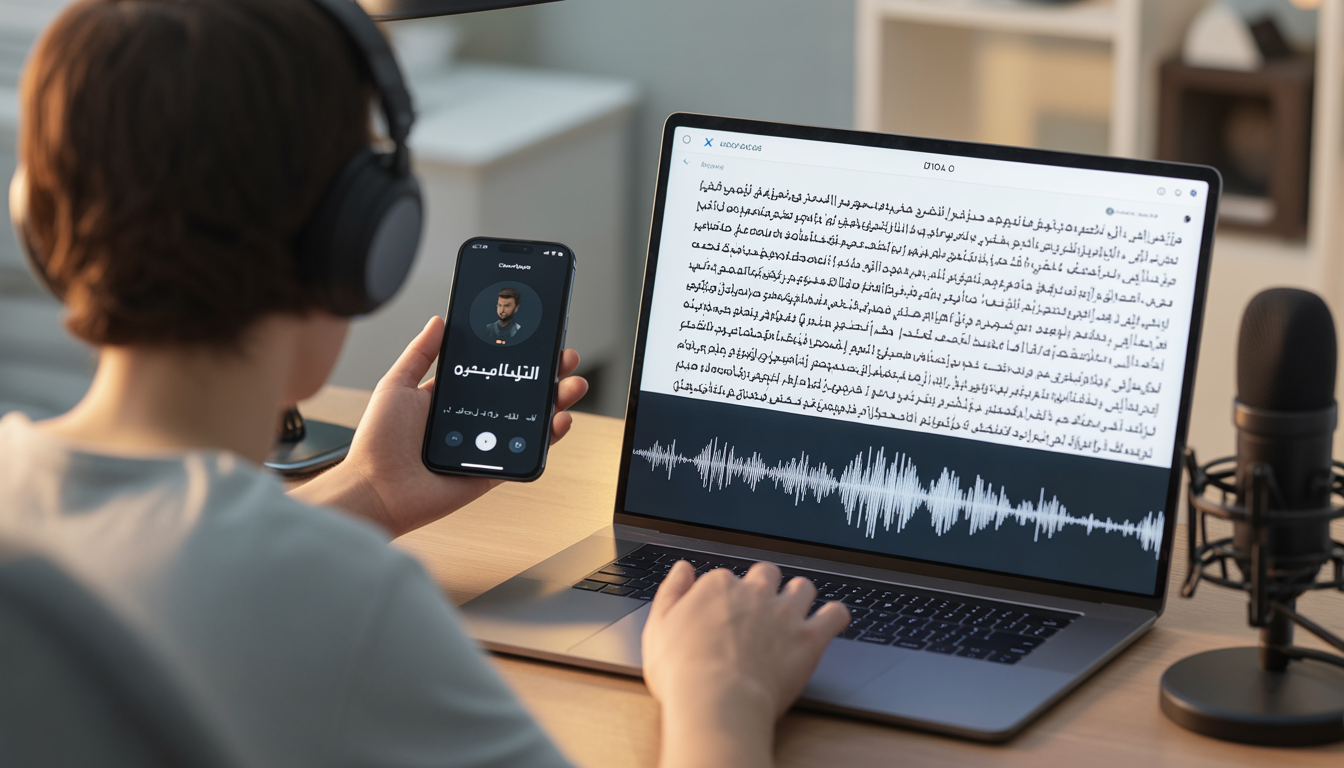
Step 3: Generate Automatic Arabic Transcription
This is where the magic happens.
What used to take hours now takes:
- 1-5 minutes for short recordings
- 10-15 minutes for longer content
And during that time, you’re free to:
- Plan your next post
- Reply to emails
- Script your next video
Modern AI transcription for Arabic can:
- Detect punctuation
- Identify multiple speakers
- Format paragraphs
- Time-stamp the text
Automatically.
Yes, it’s that fast.
Yes, it’s that powerful.
Step 4: Edit for Perfection (The 5-Minute Polish)
AI gives you 90-95% accuracy with clear audio.
Your job is not to rewrite everything.
Your job is to do a quick precision edit.
Focus only on:
- Names and brand terms
- Local dialects or regional expressions
- Technical or industry vocabulary
- Formatting for readability
This usually takes far less time than you expect.
Step 5: Repurpose the Transcript (This Is Where Creators Win)
Most beginners stop at transcription.
Top creators start there.
Your transcript is not just text, it’s a content database.
From one Arabic recording, you can extract:
Long-Form Content
- SEO blog posts
- Website articles
- Medium publications
Social Media Content
- Instagram captions
- LinkedIn posts
- Twitter/X threads
- Carousel text
Authority Content
- Email newsletters
- Lead magnets
- E-books
- Course materials
Video Content
- Subtitles
- Short-form video scripts
- Hook ideas
You’re no longer asking:
“What should I post today?”
Because your content is already created, you’re just redistributing it.
Speed vs Accuracy vs Cost, What Should You Choose?
When transcribing Arabic audio to text, your ideal method depends on one simple question:
Do you value time, precision, or budget the most?
| Method | Speed | Accuracy | Cost | Ease of Use | Best For |
| Manual transcription | Very slow | 99% | Free (time cost) | Hard | Legal, academic & Quranic text |
| AI transcription tools | Very fast | 90–95% | Low | Very easy | Creators, students & marketers |
| Freelancers | Medium | 97–99% | High | Easy | Businesses & professional projects |
Real Use Cases for Creators
Arabic audio transcription isn’t just a technical step, it’s a content multiplier for modern growth.
Here’s how different creator types turn Arabic transcripts into traffic, authority, and revenue.
1. YouTubers: Turn Videos Into Searchable Assets
YouTube helps people discover you inside the platform.
But when your Arabic videos aren’t transcribed, you miss massive Google search traffic — the most consistent, long-term source of views.
With a transcript, you can:
- Convert Arabic videos into SEO-optimized blog posts that rank for high-intent keywords
- Add accurate captions to boost watch time and retention
- Repurpose content into articles, threads, and carousels
- Translate into other languages to reach a global audience
- Write keyword-rich video descriptions in minutes
One video → a multi-platform growth engine.
2. Podcasters: From Conversations to Authority Content
Podcasts are content gold but only if they’re searchable.
Transcription allows you to:
- Publish show notes instantly without writing from scratch
- Create quote graphics for social media
- Turn episodes into long-form articles
- Extract email newsletters from every episode
- Improve discoverability through searchable text
Your podcast stops being “listen once and forget” and becomes:
Searchable
Shareable
Evergreen.
3. Course Creators: Increase Value Without Recording More
If you sell knowledge, transcription multiplies the value of your Arabic course.
You can:
- Turn lessons into downloadable PDFs and workbooks
- Make your entire course searchable
- Help students learn faster with written references
- Support different learning styles
- Create micro-content for marketing
This leads to:
- Better student experience
- Higher completion rates
- Stronger testimonials
- More sales
All without recording new lessons.
4. Short-Form Content Creators: Never Run Out of Ideas
Short-form creators always ask:
“What should I post today?”
Your transcript already has the answer.
From one Arabic recording you can:
- Extract viral hooks
- Write captions in seconds
- Find powerful one-liners
- Create multiple Reels / TikToks / Shorts
- Turn long-form content into daily posts
You move from:
Random posting → Strategic publishing
and that’s where real consistency begins.
Arabic audio → text → multi-platform content → compounding growth.
AIDA Framework: How to Transcribe Arabic Audio to Text
Attention: Your Arabic Content Is Invisible Online
You’re recording valuable Arabic audio lectures, podcasts, voice notes, interviews but search engines can’t see any of it.
No text = no indexing
No indexing = no ranking
No ranking = no traffic
Your content has depth, but it’s trapped in audio format.
You’re creating but not compounding.
Interest: Transcription Turns One Recording Into a Content Engine
When you transcribe Arabic audio to text:
- Your content becomes searchable in Arabic and even in translation
- Your videos get better watch time with captions
- Your lectures turn into structured articles
- Your quotes become social media posts
- Your voice notes become emails and newsletters
You stop thinking, “What should I post today?”
You start building a system where one recording feeds your entire content pipeline.
Desire: The Smart Creator Workflow (Built for Scale)
Imagine this:
Record once → Upload to an AI transcription tool → Get accurate Arabic text →
Then turn it into:
- A blog post
- 5-10 social media posts
- Subtitles for your videos
- An email newsletter
- Short-form content scripts
No burnout.
No content gaps.
No starting from zero every day.
This is how consistent creators grow while others struggle to keep up.
Action: Start With the Audio You Already Have
You don’t need:
- A new microphone
- New recordings
- A team
- More hours in the day
You already have the raw material.
Take one Arabic audio file today.
Upload it to a transcription tool.
Generate the text.
Turn it into your next published content.
That single transcript can become:
- Your next article
- Your next 10 posts
- Your next lead magnet
And most importantly, it becomes a permanent, searchable content asset that grows your visibility every day.
Accuracy Tips for Arabic Speech to Text
Want near-perfect results? Follow these:
- Speak clearly and at a steady pace
- Avoid background noise and echo
- Use Modern Standard Arabic (MSA) when possible for higher accuracy
- Record in a quiet room
- Use a good microphone or high-quality phone recording
- Pronounce letters fully (especially deep sounds like ع، ح، ق)
Small improvements → massive accuracy boost.
Arabic Audio to Text: Free vs Paid Tools
Free Tools Good for Beginners
Best for:
- Testing your workflow
- Short recordings
- Occasional transcription
Limitations:
- File length restrictions
- Lower accuracy with dialects
- Limited export formats
- Slower processing
Paid Tools, Best for Serious Creators
You get:
- Much higher accuracy (especially for different Arabic accents)
- Faster turnaround
- Speaker detection
- Team collaboration
- Bulk transcription
- Built-in editor & captions
If content is your business, this is an investment, not a cost.
Workflow: The Smart Creator System
Here’s the high-performance loop:
- Record your content in Arabic
- Transcribe automatically
- Edit once for clarity
- Turn it into 5-10 content assets
- Publish across all platforms
This is how you scale your content without burnout.
Frequently Asked Questions, How to Transcribe Arabic Audio to Text
Q1: What is the fastest way to transcribe Arabic audio to text?
The fastest method is using AI transcription tools. Upload your file, choose Arabic as the language, and the system converts speech into text within minutes. It’s perfect for creators who want a quick, repeatable, and scalable workflow.Q2: How accurate is AI transcription for Arabic?
Most modern tools deliver around 85-95% accuracy. Clear pronunciation, good audio quality, and minimal background noise significantly improve the results, so you’ll only need light editing before publishing.Q3: Can I transcribe Arabic audio to text for free?
Yes. Many platforms offer free minutes or trial plans. These are great for testing or short recordings, while paid versions usually provide higher accuracy, faster processing, and better export options.Q4: Which Arabic dialects are supported?
Most AI tools work best with Modern Standard Arabic (MSA) and widely spoken dialects. Strong regional slang may require small manual corrections, but the overall output is still very usable.Q5: What audio format works best?
MP3 and WAV are the most reliable formats. However, clean, noise-free audio matters more than the file type for getting a high-quality transcript.Q6: Do I need to edit AI-generated transcripts?
Yes, just a little. A quick polish helps fix names, punctuation, formatting, and dialect-specific words so your transcript becomes professional and publish-ready.Q7: Is manual transcription better than AI for Arabic?
Manual transcription can achieve higher accuracy for religious, legal, medical, or highly technical content. But for most creators, AI saves hours and is far easier to scale.Q8: Can transcripts help with SEO?
Absolutely. Transcripts turn your spoken Arabic content into searchable text, helping your videos, podcasts, and courses rank on search engines and bring long-term traffic.Q9: How long does Arabic transcription take?
AI transcription: usually a few minutesManual transcription: several hours for the same file This time difference is why most creators switch to AI.
Q10: Is transcription useful for social media creators?
It’s a huge advantage. With transcripts you can:Write captions faster
Extract viral hooks
Turn long videos into short-form content
Stay consistent without recording every day
Q11: Can I translate the Arabic transcript into other languages?
Yes. Once your audio becomes text, you can instantly translate it into multiple languages and reach a global audience with subtitles, blogs, or multilingual posts.Q12: What’s the best workflow for creators?
Keep it simple and repeatable:Record once → Transcribe → Edit → Repurpose → Publish everywhere
This turns one piece of Arabic audio into multiple content assets and helps you grow without creating from scratch every day.
The Bottom Line: Your Content Is More Valuable Than You Think
Every Arabic recording you create has untapped potential. It’s not just a lecture, a podcast, a reel, or a lesson, it can become multiple high-value content assets when you turn it into text.When you transcribe Arabic audio, one recording can transform into:
- A blog post
- Social media carousels
- Email newsletters
- Lead magnets
- YouTube captions
- Short-form video scripts
- Searchable knowledge assets
Text makes your content discoverable, repurposable, and evergreen, something audio alone can’t do.
Stop Creating More, Start Repurposing Smarter
You don’t need more time, more ideas, or more recordings.
You need a system that extracts more value from what you already have.
Arabic transcription unlocks your existing content, turning your strongest ideas, explanations, and natural speaking style into publish-ready assets in minutes.
Your Next Step
- Pick one Arabic audio or video file you’ve already recorded
- Upload it to a transcription tool
- Edit lightly for clarity
- Turn it into a blog post, captions, or an email
That’s it.
Creators who scale don’t create more they repurpose smarter, distribute wider, and let every recording multiply into multiple pieces of content.
Your voice deserves to be discovered, shared, and leveraged.
Start today and let your content work for you.