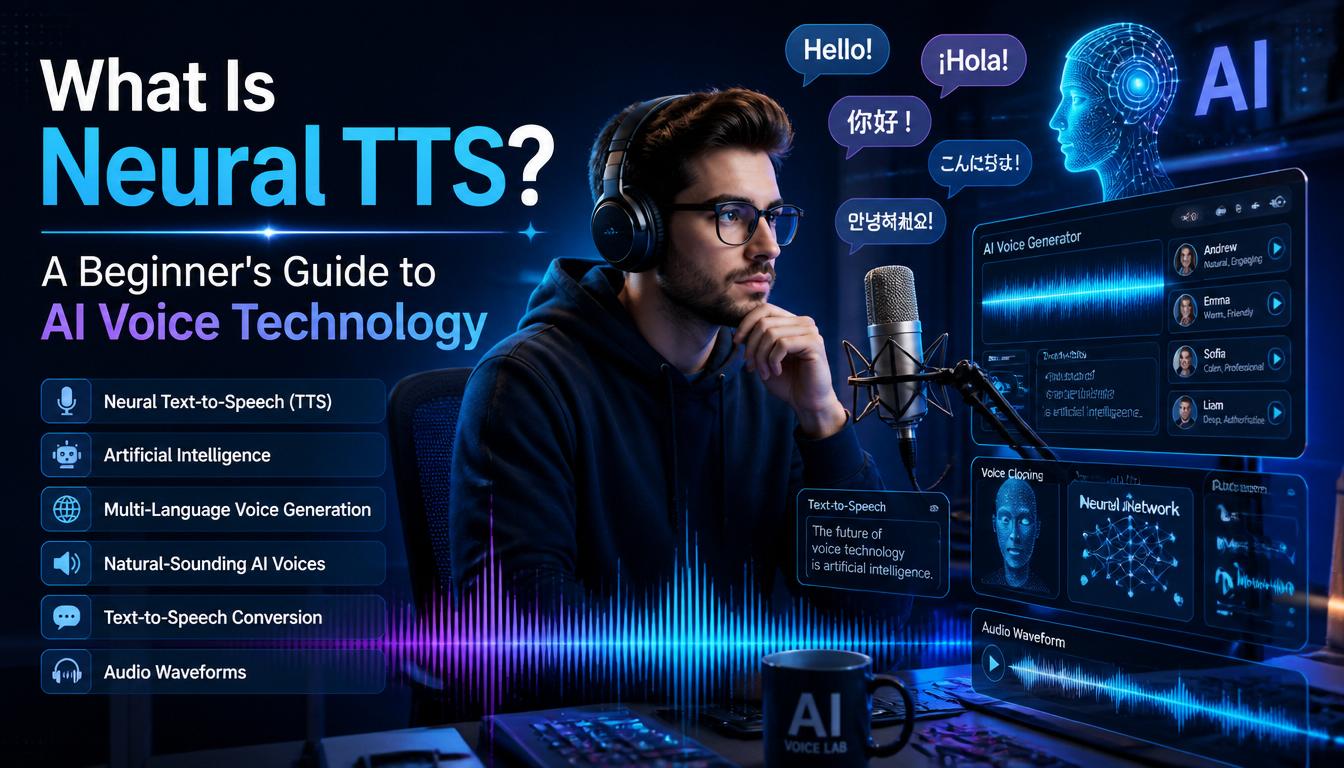
Have you ever listened to an AI voice and thought, “Wait, that actually sounds like a real person?” Just a few years ago, that would have been surprising. Today, it’s becoming the new normal. From YouTube videos and audiobooks to customer support and language learning apps, AI-generated voices are everywhere. The reason they sound so natural is a technology called Neural TTS.
But what is Neural TTS? How does it work? And why is it so much better than the robotic voices many of us remember? In this guide, you’ll learn everything you need to know about Neural TTS in simple language.
Neural TTS (Neural Text-to-Speech) is an advanced AI technology that converts written text into speech that sounds natural and human-like. Unlike older text-to-speech systems that stitched together small pieces of recorded audio, Neural TTS uses deep learning and neural networks to generate speech almost the same way humans speak.
Instead of simply reading words one by one, it understands things like:
The result is a voice that feels smooth, expressive, and easy to listen to.
For example, if the text says:
“I can’t believe we actually did it!”
A traditional TTS system might read it in a flat, emotionless voice. A Neural TTS system can add excitement, change the pitch naturally, and pause in the right places, making it sound much more like a real person.
People expect better audio quality than ever before. Whether you’re creating YouTube videos, online courses, podcasts, or customer support systems, robotic voices can make your content feel outdated.
Neural TTS solves this problem by producing voices that are:
This is why many creators and businesses are replacing traditional voiceovers with Neural TTS.
At first, Neural TTS might sound like magic but the process is actually quite logical.
Let’s break it down step by step.
Everything starts with written text.
For example:
“Welcome to our channel. Today we’re learning about AI voices.”
The system first analyzes the sentence structure instead of simply reading each word.
It identifies:
This helps the AI understand how the sentence should be spoken.
Humans don’t read every sentence the same way.
For example:
“Really?”
can sound curious, surprised, excited, or even sarcastic depending on the situation. Neural TTS tries to understand the context so it can choose a more appropriate speaking style.
It predicts:
This makes the speech sound far more realistic.
This is where the “Neural” part comes in. Neural TTS uses deep learning models trained on thousands of hours of human speech. Instead of piecing together old recordings, the AI creates entirely new speech waveforms that closely resemble real human voices.
Because the model has learned how people naturally speak, it can produce smooth and expressive audio rather than sounding robotic.
Before the final voice is generated, the AI fine-tunes several elements, including:
These small details make a surprisingly big difference in how realistic the voice sounds.
Older text-to-speech systems often sounded mechanical because they relied on pre-recorded sound fragments. Neural TTS takes a completely different approach. Instead of stitching together audio clips, it generates speech using AI models that understand how humans naturally communicate.
This allows it to create voices that are:
The improvement isn’t just noticeable, it’s dramatic.
Imagine listening to GPS directions from ten years ago versus a modern AI assistant. The difference in naturalness is a good example of how far speech technology has advanced.
You don’t need to be an AI expert to understand the basics. Neural TTS is powered by artificial intelligence and deep learning, where computer models are trained on massive collections of real human speech.
During training, the AI learns:
Over time, the model becomes capable of generating speech that closely mimics real human conversation. This learning process is what allows Neural TTS to create voices that feel alive instead of artificial.
The demand for video content, podcasts, online education, and multilingual communication has exploded. Hiring voice actors for every project can be expensive and time-consuming. Neural TTS offers a faster and more affordable alternative while maintaining impressive quality.
Today, creators use it to narrate videos, businesses use it for customer service, educators create learning materials with it, and developers integrate it into apps and virtual assistants. As AI continues to improve, Neural TTS is becoming an essential tool for anyone who wants professional-quality voice content without the traditional costs.
Neural TTS isn’t just about making AI voices sound better. It also saves time, reduces costs, and helps you create content that reaches more people. That’s why it’s becoming a go-to solution for creators, businesses, educators, and developers.
Here are some of its biggest benefits.
The biggest advantage of Neural TTS is how realistic it sounds. Modern AI voices include natural pauses, proper pronunciation, and smooth intonation. Instead of sounding flat or robotic, they feel much closer to a real human conversation.
This creates a better listening experience, especially for longer content like:
Recording voiceovers manually can take hours. If you make a mistake, you often need to re-record the entire section. With Neural TTS, you simply edit the text and generate a new voiceover in minutes.
This is especially useful for creators who regularly update videos or publish content frequently.
Hiring professional voice actors can be expensive, especially if you need content in multiple languages. Neural TTS allows businesses and creators to produce high-quality voiceovers at a fraction of the cost, making professional audio accessible even for small teams and startups.
Many Neural TTS platforms support dozens of languages and regional accents. This makes it easy to localize content for audiences around the world without recording separate voiceovers for every language.
Whether you’re creating tutorials, marketing videos, or training materials, multilingual support helps you reach a much wider audience.
Human voices naturally change due to mood, illness, or recording conditions. Neural TTS delivers the same voice quality every time, helping businesses maintain a consistent brand identity across videos, apps, and customer interactions.
Need one voiceover? That’s simple. Need 500 product descriptions or hundreds of training videos? Neural TTS can handle that too.
Because the process is automated, it’s easy to scale voice production without dramatically increasing time or costs.
Neural TTS makes digital content more accessible. It can read articles, books, and documents aloud, helping people who:
This improves the overall user experience while making content available to more people.
Neural TTS is used in many industries. Here are some of the most common examples.
YouTubers and social media creators use Neural TTS to produce:
Instead of spending hours recording audio, they can generate professional voiceovers quickly and focus on creating more content.
Want to reach viewers in different countries?
Neural TTS makes it easier to translate and dub videos into multiple languages while keeping the speech natural and engaging. This helps creators expand their global audience without hiring multiple voice actors.
Businesses use Neural TTS for:
Fast voice generation allows marketing teams to create and test multiple versions of the same campaign with ease.
Many companies now use AI-powered voices in:
Natural-sounding voices make customer interactions feel more pleasant and professional.
Teachers and online learning platforms use Neural TTS to create:
Students benefit from clear and engaging audio, making learning more enjoyable.
Publishers and independent authors can turn written books into spoken audio much faster using Neural TTS. While many premium audiobooks still use human narrators, AI voices are becoming a practical option for educational content, guides, and shorter publications.
Game developers use Neural TTS to create:
This speeds up development while reducing recording costs.
Many screen readers and assistive technologies now rely on Neural TTS to provide more natural speech, helping users navigate websites, documents, and applications comfortably.
Creating professional voiceovers can be expensive, time-consuming, and difficult, especially if you need content in multiple languages.
Poor-quality audio can make even great videos feel unprofessional. Robotic voices often reduce viewer engagement and may cause people to stop watching or listening sooner.
Neural TTS solves these challenges by generating realistic, human-like voices in minutes. You can create high-quality voiceovers, update scripts quickly, and localize content for global audiences without the traditional cost and effort.
As AI technology continues to improve, Neural TTS has become the preferred choice for applications where natural, high-quality speech matters.
If you’re looking for an all-in-one solution for video localization and AI voice generation, dubRight is an excellent choice.
It combines advanced Neural TTS with multilingual dubbing and realistic voice output, helping creators and businesses produce professional-quality content for audiences around the world. Whether you’re creating marketing videos, educational content, or social media clips, dubRight simplifies the entire workflow from script to final voiceover.
Neural TTS has improved rapidly over the past few years, and it’s still evolving. Future AI voices are expected to become even more expressive, realistic, and adaptable.
Some exciting developments include:
As these technologies continue to advance, the gap between AI-generated speech and human speech will become even smaller. For creators and businesses, this means producing high-quality audio will become faster, easier, and more affordable than ever.
Neural TTS is widely used in:
If you’re looking for an easy-to-use platform that combines realistic AI voices with multilingual dubbing and video localization, dubRight is a strong choice. Other popular options include ElevenLabs, Google Cloud Text-to-Speech, Microsoft Azure AI Speech, Amazon Polly, Murf AI, and PlayHT.
Neural TTS has transformed the way we create and use digital voices. What once sounded robotic and unnatural has evolved into speech that is smooth, expressive, and remarkably human-like. Whether you’re producing YouTube videos, building an app, creating online courses, recording audiobooks, or expanding your business into new markets, Neural TTS can help you save time, reduce costs, and deliver a better experience for your audience.
The technology is no longer just for large companies. Today, creators, educators, marketers, and businesses of all sizes can use AI-powered voices to produce professional-quality content in multiple languages with minimal effort. As AI voice technology continues to advance, adopting Neural TTS now can give you a head start in creating engaging, accessible, and scalable content
But what is Neural TTS? How does it work? And why is it so much better than the robotic voices many of us remember? In this guide, you’ll learn everything you need to know about Neural TTS in simple language.
What Is Neural TTS?
Neural TTS (Neural Text-to-Speech) is an advanced AI technology that converts written text into speech that sounds natural and human-like. Unlike older text-to-speech systems that stitched together small pieces of recorded audio, Neural TTS uses deep learning and neural networks to generate speech almost the same way humans speak.
Instead of simply reading words one by one, it understands things like:
- Pronunciation
- Tone of voice
- Emotion
- Rhythm
- Pauses
- Pitch
- Speaking style
The result is a voice that feels smooth, expressive, and easy to listen to.
For example, if the text says:
“I can’t believe we actually did it!”
A traditional TTS system might read it in a flat, emotionless voice. A Neural TTS system can add excitement, change the pitch naturally, and pause in the right places, making it sound much more like a real person.
Why Does Neural TTS Matter?
People expect better audio quality than ever before. Whether you’re creating YouTube videos, online courses, podcasts, or customer support systems, robotic voices can make your content feel outdated.
Neural TTS solves this problem by producing voices that are:
- More natural
- Easier to understand
- Pleasant to listen to
- More engaging
- Suitable for long-form content
This is why many creators and businesses are replacing traditional voiceovers with Neural TTS.
How Does Neural TTS Work?
At first, Neural TTS might sound like magic but the process is actually quite logical.
Let’s break it down step by step.
Step 1: The AI Reads the Text
Everything starts with written text.
For example:
“Welcome to our channel. Today we’re learning about AI voices.”
The system first analyzes the sentence structure instead of simply reading each word.
It identifies:
- Words
- Punctuation
- Numbers
- Dates
- Symbols
- Abbreviations
This helps the AI understand how the sentence should be spoken.
Step 2: The AI Understands Context
Humans don’t read every sentence the same way.
For example:
“Really?”
can sound curious, surprised, excited, or even sarcastic depending on the situation. Neural TTS tries to understand the context so it can choose a more appropriate speaking style.
It predicts:
- Where to pause
- Which words to emphasize
- When to raise or lower the pitch
- How quickly to speak
This makes the speech sound far more realistic.
Step 3: Neural Networks Generate Speech
This is where the “Neural” part comes in. Neural TTS uses deep learning models trained on thousands of hours of human speech. Instead of piecing together old recordings, the AI creates entirely new speech waveforms that closely resemble real human voices.
Because the model has learned how people naturally speak, it can produce smooth and expressive audio rather than sounding robotic.
Step 4: The Audio Is Refined
Before the final voice is generated, the AI fine-tunes several elements, including:
- Natural breathing patterns
- Smooth transitions between words
- Accurate pronunciation
- Emotional expression
- Consistent speaking pace
These small details make a surprisingly big difference in how realistic the voice sounds.
What Makes Neural TTS Different from Traditional Text-to-Speech?
Older text-to-speech systems often sounded mechanical because they relied on pre-recorded sound fragments. Neural TTS takes a completely different approach. Instead of stitching together audio clips, it generates speech using AI models that understand how humans naturally communicate.
This allows it to create voices that are:
- More expressive
- Better at handling long sentences
- More consistent
- More realistic
- Easier to understand
The improvement isn’t just noticeable, it’s dramatic.
Imagine listening to GPS directions from ten years ago versus a modern AI assistant. The difference in naturalness is a good example of how far speech technology has advanced.
The Technology Behind Neural TTS
You don’t need to be an AI expert to understand the basics. Neural TTS is powered by artificial intelligence and deep learning, where computer models are trained on massive collections of real human speech.
During training, the AI learns:
- How words are pronounced
- How sentences flow
- Where speakers naturally pause
- How emotions affect speech
- How different accents and voices sound
Over time, the model becomes capable of generating speech that closely mimics real human conversation. This learning process is what allows Neural TTS to create voices that feel alive instead of artificial.
Why Is Neural TTS Becoming So Popular?
The demand for video content, podcasts, online education, and multilingual communication has exploded. Hiring voice actors for every project can be expensive and time-consuming. Neural TTS offers a faster and more affordable alternative while maintaining impressive quality.
Today, creators use it to narrate videos, businesses use it for customer service, educators create learning materials with it, and developers integrate it into apps and virtual assistants. As AI continues to improve, Neural TTS is becoming an essential tool for anyone who wants professional-quality voice content without the traditional costs.
Benefits of Neural TTS
Neural TTS isn’t just about making AI voices sound better. It also saves time, reduces costs, and helps you create content that reaches more people. That’s why it’s becoming a go-to solution for creators, businesses, educators, and developers.
Here are some of its biggest benefits.
1. Natural-Sounding Voices
The biggest advantage of Neural TTS is how realistic it sounds. Modern AI voices include natural pauses, proper pronunciation, and smooth intonation. Instead of sounding flat or robotic, they feel much closer to a real human conversation.
This creates a better listening experience, especially for longer content like:
- YouTube videos
- Podcasts
- Audiobooks
- Online courses
- Product tutorials
2. Save Time
Recording voiceovers manually can take hours. If you make a mistake, you often need to re-record the entire section. With Neural TTS, you simply edit the text and generate a new voiceover in minutes.
This is especially useful for creators who regularly update videos or publish content frequently.
3. Lower Production Costs
Hiring professional voice actors can be expensive, especially if you need content in multiple languages. Neural TTS allows businesses and creators to produce high-quality voiceovers at a fraction of the cost, making professional audio accessible even for small teams and startups.
4. Multilingual Support
Many Neural TTS platforms support dozens of languages and regional accents. This makes it easy to localize content for audiences around the world without recording separate voiceovers for every language.
Whether you’re creating tutorials, marketing videos, or training materials, multilingual support helps you reach a much wider audience.
5. Consistent Voice Quality
Human voices naturally change due to mood, illness, or recording conditions. Neural TTS delivers the same voice quality every time, helping businesses maintain a consistent brand identity across videos, apps, and customer interactions.
6. Easy to Scale
Need one voiceover? That’s simple. Need 500 product descriptions or hundreds of training videos? Neural TTS can handle that too.
Because the process is automated, it’s easy to scale voice production without dramatically increasing time or costs.
7. Better Accessibility
Neural TTS makes digital content more accessible. It can read articles, books, and documents aloud, helping people who:
- Have visual impairments
- Have reading difficulties
- Prefer listening over reading
- Learn better through audio
This improves the overall user experience while making content available to more people.
Common Use Cases of Neural TTS
Neural TTS is used in many industries. Here are some of the most common examples.
Content Creation
YouTubers and social media creators use Neural TTS to produce:
- Video narrations
- Shorts and Reels
- Tutorials
- Explainer videos
- Documentary-style content
Instead of spending hours recording audio, they can generate professional voiceovers quickly and focus on creating more content.
Video Localization:
Want to reach viewers in different countries?
Neural TTS makes it easier to translate and dub videos into multiple languages while keeping the speech natural and engaging. This helps creators expand their global audience without hiring multiple voice actors.
Marketing and Advertising
Businesses use Neural TTS for:
- Product videos
- Promotional campaigns
- Social media ads
- Brand storytelling
- Sales presentations
Fast voice generation allows marketing teams to create and test multiple versions of the same campaign with ease.
Customer Support
Many companies now use AI-powered voices in:
- Interactive Voice Response (IVR) systems
- Virtual assistants
- Phone support
- Automated help centers
Natural-sounding voices make customer interactions feel more pleasant and professional.
Education
Teachers and online learning platforms use Neural TTS to create:
- Video lessons
- Language learning materials
- Educational presentations
- Course narrations
Students benefit from clear and engaging audio, making learning more enjoyable.
Audiobooks
Publishers and independent authors can turn written books into spoken audio much faster using Neural TTS. While many premium audiobooks still use human narrators, AI voices are becoming a practical option for educational content, guides, and shorter publications.
Gaming
Game developers use Neural TTS to create:
- Character dialogue
- Tutorial narration
- NPC voices
- Dynamic conversations
This speeds up development while reducing recording costs.
Accessibility Tools
Many screen readers and assistive technologies now rely on Neural TTS to provide more natural speech, helping users navigate websites, documents, and applications comfortably.
PAS Framework: Why More People Are Switching to Neural TTS
Problem
Creating professional voiceovers can be expensive, time-consuming, and difficult, especially if you need content in multiple languages.
Agitate
Poor-quality audio can make even great videos feel unprofessional. Robotic voices often reduce viewer engagement and may cause people to stop watching or listening sooner.
Solution
Neural TTS solves these challenges by generating realistic, human-like voices in minutes. You can create high-quality voiceovers, update scripts quickly, and localize content for global audiences without the traditional cost and effort.
Neural TTS vs Traditional TTS
| Feature | Neural TTS | Traditional TTS |
| Voice Quality | Very natural and expressive | Robotic and monotone |
| Pronunciation | Highly accurate | Often inconsistent |
| Emotional Expression | Yes | Very limited |
| Speaking Rhythm | Human-like | Mechanical |
| Language Support | Extensive | More limited |
| Voice Customization | Advanced | Basic |
| Listener Experience | Engaging | Less natural |
| Best For | Modern content, apps, videos, and businesses | Basic notifications and simple reading tasks |
Popular Neural TTS Tools
Several AI-powered platforms offer Neural TTS capabilities. The right choice depends on your goals, workflow, and budget.| Software | Best For | Key Strength |
| dubRight | Creators, businesses & marketers | High-quality AI dubbing, realistic Neural TTS voices, multilingual support, accurate lip-sync, and an easy-to-use workflow |
| ElevenLabs | Realistic AI voices | Excellent voice quality and advanced voice cloning |
| Google Cloud Text-to-Speech | Developers | Powerful APIs with many language options |
| Microsoft Azure AI Speech | Enterprise applications | Custom voice creation and scalable cloud services |
| Amazon Polly | Apps and businesses | Reliable text-to-speech with multiple voice styles |
| Murf AI | Business presentations | Studio-quality AI voiceovers |
| PlayHT | Podcasts and content creation | Large library of realistic AI voices |
Why dubRight Stands Out
If you’re looking for an all-in-one solution for video localization and AI voice generation, dubRight is an excellent choice.
It combines advanced Neural TTS with multilingual dubbing and realistic voice output, helping creators and businesses produce professional-quality content for audiences around the world. Whether you’re creating marketing videos, educational content, or social media clips, dubRight simplifies the entire workflow from script to final voiceover.
Best Practices for Using Neural TTS
- Write Like People Speak
- Use Proper Punctuation
- Choose the Right Voice
- Don’t Overuse Emotion
- Always Listen Before Publishing
The Future of Neural TTS
Neural TTS has improved rapidly over the past few years, and it’s still evolving. Future AI voices are expected to become even more expressive, realistic, and adaptable.
Some exciting developments include:
- Better emotional expression
- More natural conversations
- Improved multilingual support
- Real-time voice translation
- Personalized AI voices
- Faster voice generation
- Greater accessibility features
As these technologies continue to advance, the gap between AI-generated speech and human speech will become even smaller. For creators and businesses, this means producing high-quality audio will become faster, easier, and more affordable than ever.
Frequently Asked Questions (FAQs)
1. What is Neural TTS?
Neural TTS (Neural Text-to-Speech) is an AI technology that converts written text into natural-sounding speech using deep learning models. It produces voices that sound much more human than traditional text-to-speech systems.2. How is Neural TTS different from traditional TTS?
Traditional TTS often relies on pre-recorded audio segments, which can sound robotic. Neural TTS generates speech using AI models, resulting in smoother pronunciation, natural pauses, and more expressive voices.3. Is Neural TTS free?
Some platforms offer free plans or limited trials, while others require a subscription for premium voices, advanced features, or higher usage limits.4. Can Neural TTS create different voices?
Yes. Most modern Neural TTS platforms offer a variety of male and female voices, different accents, speaking styles, and sometimes even custom voice options.5. Which industries use Neural TTS?
Neural TTS is widely used in:
- Content creation
- Education
- Marketing
- Customer support
- Gaming
- Healthcare
- Audiobooks
- Accessibility tools
- Mobile apps
6. Is Neural TTS good for YouTube videos?
Absolutely. Many YouTube creators use Neural TTS for tutorials, explainers, documentaries, educational content, and multilingual video dubbing because it saves time while maintaining professional audio quality.7. Can Neural TTS support multiple languages?
Yes. Most leading platforms support dozens of languages and regional accents, making it easier to localize videos, courses, and business content for global audiences.8. Does Neural TTS replace human voice actors?
Not entirely, Human voice actors are still the best choice for highly emotional performances, movies, and complex storytelling. However, Neural TTS is an excellent solution for many everyday projects, including tutorials, marketing videos, customer support, and training materials.9. What is the best Neural TTS software?
The best tool depends on your needs.If you’re looking for an easy-to-use platform that combines realistic AI voices with multilingual dubbing and video localization, dubRight is a strong choice. Other popular options include ElevenLabs, Google Cloud Text-to-Speech, Microsoft Azure AI Speech, Amazon Polly, Murf AI, and PlayHT.
10. Is Neural TTS the future of AI voice technology?
Yes. As AI models continue to improve, Neural TTS is becoming the standard for high-quality voice generation. It’s expected to play a major role in content creation, digital assistants, accessibility, education, and global communication.Conclusion
Neural TTS has transformed the way we create and use digital voices. What once sounded robotic and unnatural has evolved into speech that is smooth, expressive, and remarkably human-like. Whether you’re producing YouTube videos, building an app, creating online courses, recording audiobooks, or expanding your business into new markets, Neural TTS can help you save time, reduce costs, and deliver a better experience for your audience.
The technology is no longer just for large companies. Today, creators, educators, marketers, and businesses of all sizes can use AI-powered voices to produce professional-quality content in multiple languages with minimal effort. As AI voice technology continues to advance, adopting Neural TTS now can give you a head start in creating engaging, accessible, and scalable content